
Agencies
Independent pre-launch validation, temporary QA capacity, or test automation for a client delivery without expanding the permanent team.
I test websites and web products across the user experience, responsive behavior, forms, APIs, CMS workflows, and critical release paths, then add focused automation where it can provide lasting value.
This service is for agencies, product teams, and website or product owners who need additional confidence before launch or a stronger quality layer in an existing delivery workflow.
The engagement can provide an independent review before an important release, additional QA capacity during delivery, or repeatable automated coverage for behavior that should remain reliable over time.
Independent pre-launch validation, temporary QA capacity, or test automation for a client delivery without expanding the permanent team.
Focused exploratory testing, clearer defect evidence, regression coverage, API or CMS validation, and maintainable automation around critical workflows.
A review before launch, after significant changes, or when recurring defects and uncertain release quality are becoming difficult to manage.
The exact combination depends on the product, its delivery workflow, and the decisions the testing needs to support. An engagement can cover a focused review, an automation implementation, or both.
Risk-based testing of the agreed areas, with attention to behavior that affects real users and important release decisions.
Practical checks sized for small and medium websites or focused product areas, used to identify significant issues that deserve attention.
Findings include enough context to support a decision, investigation, or fix instead of leaving the team with a vague list of observations.
Automation is selected according to risk, repetition, and maintenance value rather than maximizing test count without a clear purpose.
For suitable WordPress projects, an authorized CMS interface can let a non-technical user start the agreed automated checks with one button and view a tailored summary report directly inside WordPress.
The workflow runs without exposing routine access to GitHub, CI credentials, deployment settings, or command-line tools. The checks, available environments, and reporting detail are defined for the individual project.
*Quality baselines are practical web checks, not a replacement for specialist performance engineering, a formal accessibility audit, penetration testing, or compliance certification.
Since 2018, my Technical Support Engineer work at Elegant Themes has involved investigating thousands of customer-reported issues across live WordPress environments and turning incomplete user context into reproducible technical evidence.
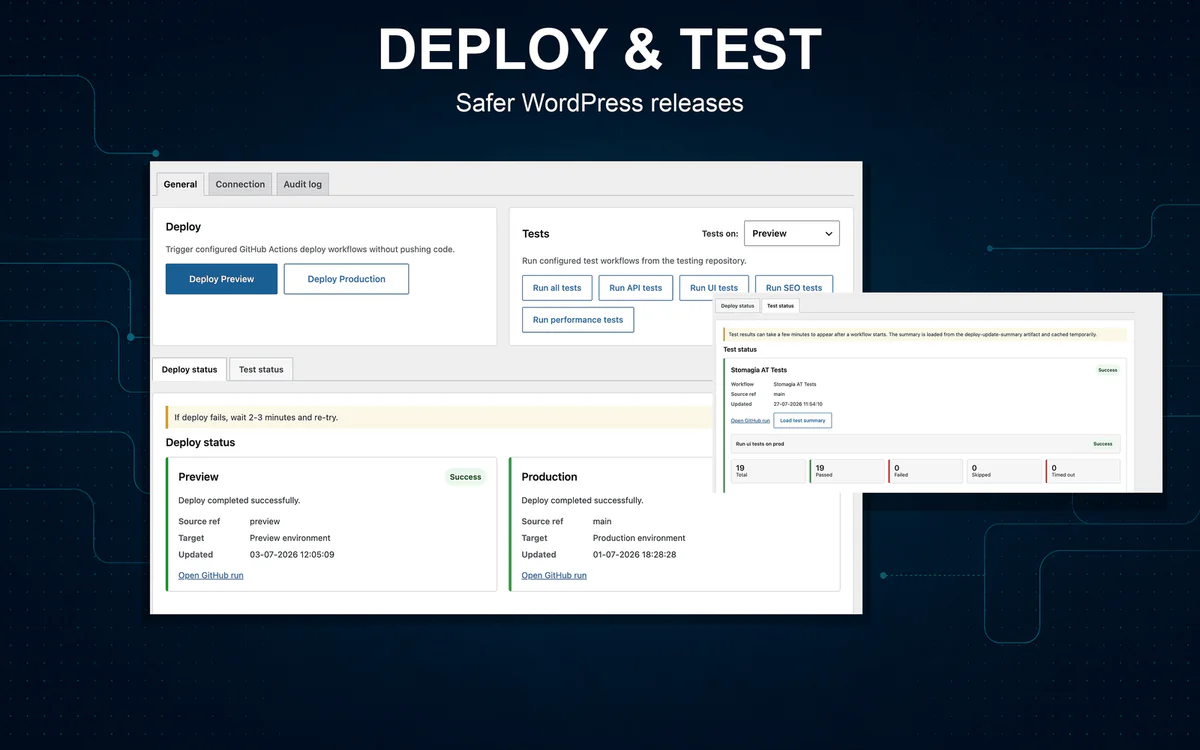
A public plugin for operating configured Preview, Production, and test workflows without routine GitHub access. Coverage includes PHPUnit, Playwright admin and security tests, mocked APIs, permissions, concurrency, authentication, and release installation.
This is also the plugin used in headless website deliveries so authorized users can start configured tests and controlled workflows from WordPress.
View Deploy & Test case study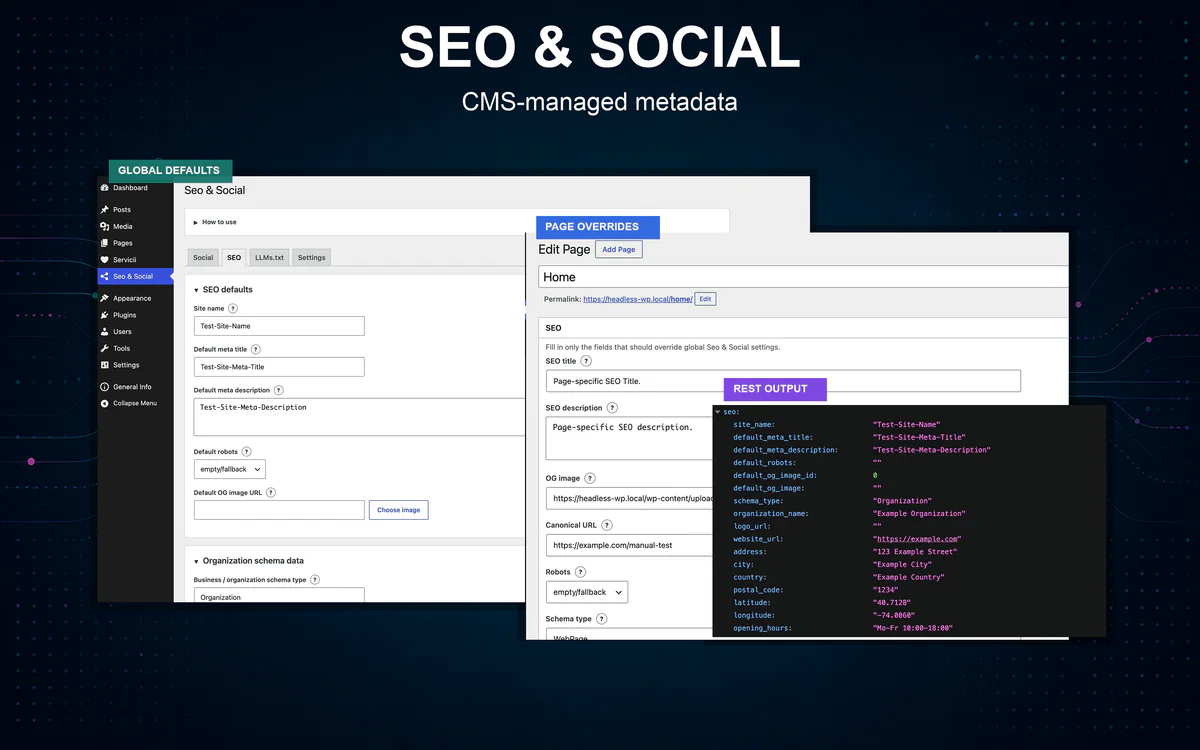
A public headless WordPress plugin for metadata, social, schema, FAQ, Open Graph image, and LLM source-data workflows.
Its evidence includes a structured manual baseline, PHPUnit integration coverage, Playwright admin tests, REST-contract validation, compatibility checks, and verified packaged releases.
View SEO & Social case studyEach engagement begins by identifying the relevant risk, available access, and evidence the team needs from the work.
You send the product stage, areas needing attention, intended release or decision, known concerns, and relevant constraints.
We define the environments, workflows, browsers, devices, APIs, CMS areas, roles, repositories, and explicit authorization required.
You receive the agreed QA scope, deliverables, price, and estimated timeline before access is provided and work begins.
I identify the highest-value risks, prepare the environments or automation structure, and perform the agreed checks.
You receive prioritized evidence, a release summary, automated tests, workflow integration, or documentation according to scope.
Where included, resolved defects are retested and automation is handed over with the agreed execution and maintenance guidance.
QA can reduce uncertainty, expose important risk, and improve release confidence, but a finite review or automated suite cannot prove that a website or product contains no defects.
Pages, workflows, browsers, viewports, devices, environments, integrations, APIs, roles, and data conditions are defined per engagement. Coverage outside that agreement is not assumed.
The review identifies, documents, prioritizes, and retests issues according to the deliverables. Product fixes, redesign, content correction, and infrastructure repair are not included unless explicitly added.
Tests may require updates when workflows, interfaces, selectors, APIs, authentication, environments, or dependencies change. Ongoing maintenance and suite expansion are separate unless agreed.
Lighthouse and targeted performance checks do not replace load, stress, scalability, or specialist performance engineering. Accessibility-conscious checks are not formal WCAG conformance testing or certification.
Security checks are explicitly authorized and limited to the agreed system and surfaces. This service does not provide penetration testing, red-team exercises, compliance audits, destructive testing, social engineering, or denial-of-service testing.
Results can be affected by configuration, test data, access restrictions, APIs, browsers, devices, hosting, and third-party services. Behavior outside the project team’s control cannot be guaranteed.
Send a short written overview of the website or product, its current stage, the areas that concern you, and what you need from the QA work. You do not need a complete test plan.
I will review the information and reply by email if the engagement appears suitable or if I need specific technical details to assess the scope.
Prefer email? Write directly to [email protected].